Small federal contractors need a manageable list of work they can pursue. The linked Reddit discussions cover how to avoid treating SAM.gov as an undifferentiated firehose, how to identify the buyers who already purchase a capability, and how to turn incumbent and period-of-performance research into a list of contracts worth pursuing.
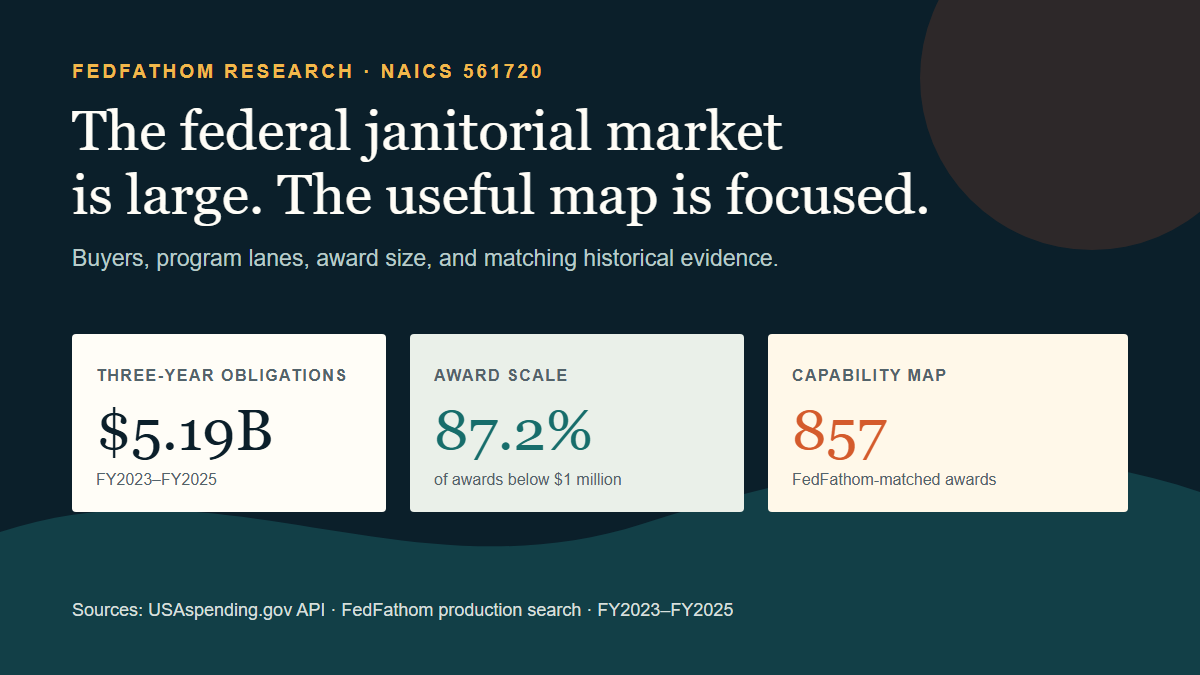
This report examines NAICS 561720: Janitorial Services. It uses official USAspending data to measure reported activity under that code, and a FedFathom capability search to identify awards for further research. Using FedFathom, we identified 857 matching awards and the buyers and incumbents behind them. The search results are a subset and should be read separately from the USAspending totals.
The market reached $5.188 billion and grew in each fiscal year
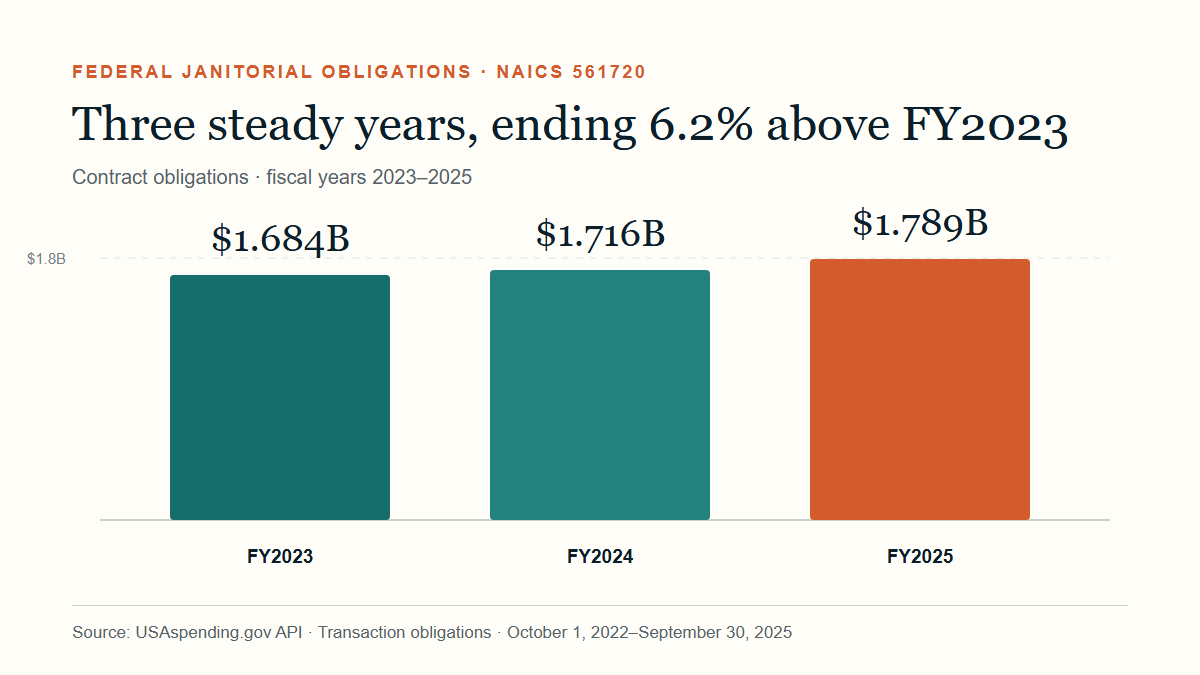
Using the USAspending API, we filtered contract awards to NAICS 561720 for FY2023 through FY2025. The filter returned $5.188 billion in obligations across 12,088 contract awards.
| Fiscal year | Contract obligations | Year-over-year change |
|---|---|---|
| FY2023 | $1.684 billion | — |
| FY2024 | $1.716 billion | +1.9% |
| FY2025 | $1.789 billion | +4.2% |
| Three-year total | $5.188 billion | +6.2% FY23-FY25 |
Obligations rose in each of the three years. That is too short a window to establish a long-term trend, and the total includes work a given small contractor may be unable to pursue.
DoD accounted for two-thirds of obligations
The Department of Defense accounted for 67.0% of filtered obligations. The three largest agencies, DoD, DHS, and VA, accounted for 79.5%; the top five reached 86.0%.
| Awarding agency | FY2023–FY2025 obligations | Share |
|---|---|---|
| Department of Defense | $3.477 billion | 67.0% |
| Department of Homeland Security | $328.3 million | 6.3% |
| Department of Veterans Affairs | $321.7 million | 6.2% |
| General Services Administration | $178.4 million | 3.4% |
| Department of Transportation | $153.9 million | 3.0% |
Looking at the organizations within those agencies helps narrow the list. The Army represented $1.568 billion, followed by the Navy at $799.8 million and the Air Force at $656.1 million. Outside those military buyers, the VA, Defense Health Agency, GSA Public Buildings Service, FAA, Customs and Border Protection, Federal Law Enforcement Training Centers, and FBI were prominent.
These buyers operate military installations, hospitals, federal office buildings, airports, border facilities, and training centers. A contractor should choose the facilities it can credibly serve before building an agency list.
Small businesses received 55.8% of awards and 36.7% of obligations
USAspending's small-business recipient filter returned 6,744 awards, or 55.8% of the market's award count. Those awards represented $1.902 billion, or 36.7% of obligations.
For a small contractor, award size and procurement program help narrow the work worth pursuing.
AbilityOne-tagged awards accounted for 54.1% of obligations
Awards tagged for the AbilityOne Program represented $2.806 billion, or 54.1% of obligations, and 3,553 awards in this filter. These recipient designations should not be added to the small-business figures; they are separate, non-exclusive views of the same market.
The Federal Acquisition Regulation makes AbilityOne Procurement List products and services mandatory sources when they meet an agency's requirement. Check which facilities and requirements are already served through AbilityOne, which work is competed through small-business programs, and where subcontracting or teaming may be viable.
Most awards were below $1 million
87.2% of all awards were below $1 million. Among awards associated with small-business-tagged recipients, 90.3% were below $1 million.
| Award-size band | All awards | All-award share | Small-business-tagged awards |
|---|---|---|---|
| Below $100,000 | 7,318 | 60.5% | 4,148 |
| $100,000 to below $1 million | 3,227 | 26.7% | 1,940 |
| $1 million to below $10 million | 1,369 | 11.3% | 612 |
| $10 million and above | 174 | 1.4% | 44 |
Award amount is not the same as obligations in a fiscal year, and neither is a proxy for profit. A contractor can start by studying recurring requirements below $1 million in one geography or group of facilities.
Search beyond the main janitorial code
PSC S201, custodial and janitorial services, represented $4.161 billion and 80.2% of obligations. Together with S299 (other housekeeping services) and Q901 (healthcare environmental cleaning), it accounted for 93.2% of obligations.
| PSC | Purchasing category | Obligations |
|---|---|---|
| S201 | Custodial and janitorial services | $4.161 billion |
| S299 | Other housekeeping services | $374.4 million |
| Q901 | Healthcare environmental cleaning | $302.3 million |
| S203 | Housekeeping: food | $139.3 million |
| S216 | Facilities operations support | $53.0 million |
For a general office-cleaning company, S201 is the main code to track. A contractor with hospital, food-service, grounds, waste, or facilities-operations experience should also track the adjacent vocabulary that matches its actual past performance.
Set-aside history helps identify work to pursue
Selected set-aside filters returned $339.7 million across 3,041 awards under the total small-business set-aside code; $454.8 million across 644 awards under the combined 8(a) competed and sole-source codes; and $245.6 million across 532 awards under the combined SDVOSB competed and sole-source codes.
These selected categories do not cover the entire market and should not be added together. Blank and other classifications exist, while program eligibility and acquisition strategy must be checked award by award. The FPDS set-aside definitions are the starting point for interpreting the codes.
A FedFathom capability search returned 857 awards
To find awards matching a specific capability, we ran this description in FedFathom:
Janitorial, custodial, and building cleaning services for federal offices, medical facilities, and military installations.
We limited the search to October 1, 2022 through September 30, 2025 and required NAICS 561720. FedFathom returned 857 matching contract awards with these filters. Of those, 810 used PSC S201, or 94.5% of the result set.
A buyer worth investigating: USDA
| Agency in the FedFathom snapshot | Matching awards |
|---|---|
| Department of Agriculture | 240 |
| Department of Defense | 154 |
| Department of the Interior | 86 |
| Department of Veterans Affairs | 78 |
| Department of State | 69 |
| Department of Transportation | 66 |
| Department of Homeland Security | 49 |
USDA accounted for 28.0% of matched awards, while DoD led the broader USAspending results by obligations. These measure different things: award counts within one capability search and dollars across the full NAICS filter. A smaller contractor can use the search results to investigate recurring requirements in the places it serves.
Incumbents and source awards to investigate
Frequent awardees in the matched set included Reliance Contractors, Germrip, X-Clean, Fortazo, Eco-Friendly Cleaning Specialist, North Bay Rehabilitation Services, Hamhed, and LOCG. Use these names for further research. Recipient records were not consolidated by parent company, so the list should not be treated as a company-level market share ranking.
| Buyer | Vendor | Codes | Official evidence |
|---|---|---|---|
| VA | Federal Medical Services | 561720 / S201 | View award |
| Washington Headquarters Services | R&R Janitorial | 561720 / S201 | View award |
| Defense Media Activity | Takeuchi Commercial Cleaning | 561720 / S211 | View award |
| Department of Justice | Chimes DC | 561720 / S201 | View award |
FedFathom also grouped common language such as “option year” and identified historical period-end dates. Those dates can guide follow-up research, but they do not confirm a recompete. Check each one against the source award record, agency forecast, and SAM.gov Contract Opportunities.
A five-step market-entry plan
Choose one operating environment
Start with the facilities your references support: offices, military installations, medical facilities, airports, laboratories, or another defined environment.
Separate addressable work from the headline total
Check AbilityOne status, incumbent history, set-aside codes, award size, geography, and contract vehicle before adding an award to your prospect list.
Build an account list from both dollars and frequency
DoD accounted for the most obligations. Also investigate USDA, DOI, State, and DOT where their recurring requirements match your services and geography.
Follow incumbents and option timing
Study who performs comparable work, what the buyer calls it, and when the current period may end. Use those signals to begin relationships before a solicitation appears.
Confirm the live acquisition in official systems
Use historical research to narrow your monitoring, then verify live notices, amendments, deadlines, and eligibility in SAM.gov and the agency's own forecast or procurement channels.
FedFathom lets you search with a description of your services and review matching historical awards by buyer, vendor, code, and period-end date. Create an account to run five free searches and build a list of awards to investigate. Confirm material facts and live opportunities in official government sources before deciding what to pursue.
Methodology and limitations
Analysis was performed September 3, 2026. USAspending filters covered October 1, 2022 through September 30, 2025; contract award type codes A, B, C, and D; and required NAICS 561720. Dollar totals are transaction obligations. Counts refer to distinct awards; dollar totals come from transactions associated with those awards. Obligations can include positive and negative modifications and are not ceilings, revenue, profit, or a forecast.
Award-size bands use non-overlapping award-amount filters, not fiscal-year obligation totals. Recipient business-type filters reflect reported designations and are not mutually exclusive. Recipient rows were not consolidated into economic parents. Selected set-aside filters do not exhaust every blank or classified record.
The FedFathom analysis uses a fixed snapshot of 857 awards returned by the query and filters stated above. Its similarity values are ranking heuristics, not probabilities. Matched counts describe that snapshot, not the complete NAICS market. Period-end dates are research signals rather than confirmed recompetes.