What this analysis covers
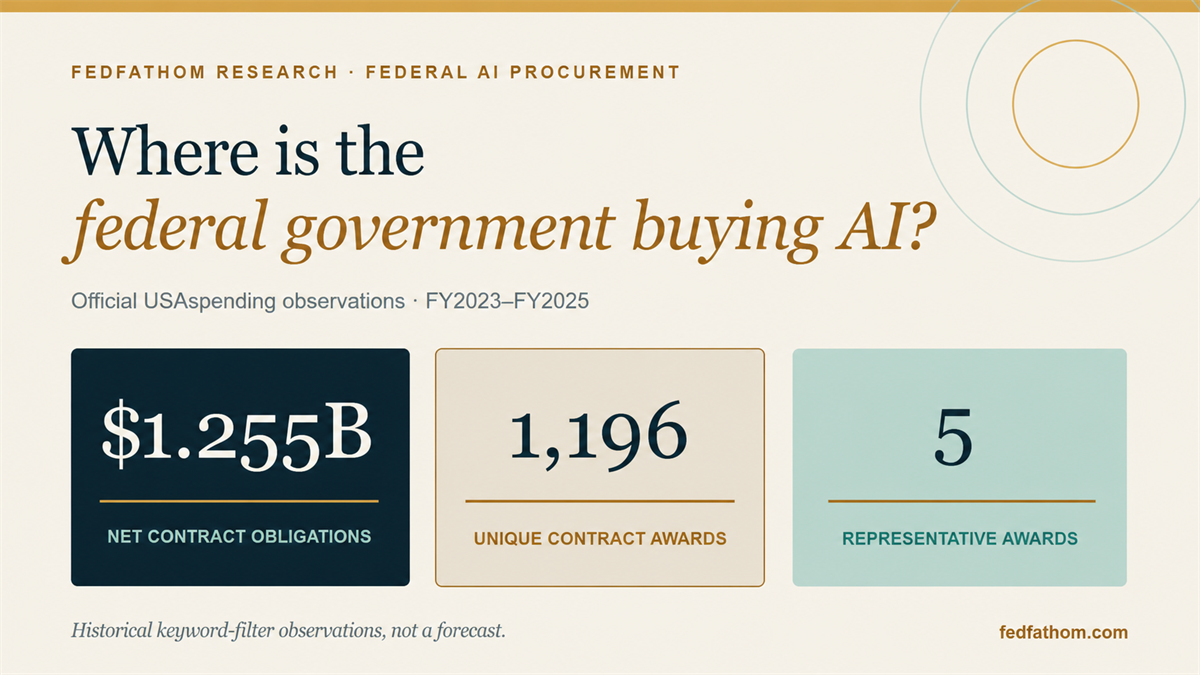
The Official USAspending observation set measures historical contract activity found by a disclosed keyword filter. Transaction obligations show dollar activity, while unique award records show the contracts returned by the filter.
All figures describe historical records within the stated boundaries. They are not a forecast or an estimate of the full federal AI market.
What the official filter measured
The official filter covered contract activity from October 1, 2022 through September 30, 2025, the complete date window for FY2023 through FY2025. It used contract award type codes A, B, C, and D and one combined USAspending keyword filter containing:
- artificial intelligence
- machine learning
- generative AI
- large language model
- natural language processing
- computer vision
- predictive analytics
USAspending controls the server-side matching behavior. This analysis added no local stemming, case folding, plural expansion, or synonym expansion and makes no claim about the platform's exact search semantics. The result is a keyword-defined observation set, not a complete definition of federal AI procurement.
Observed transaction obligations
At the transaction level, USAspending reported the following net federal action obligations. Displayed values are rounded to the nearest $1 million from the exact source figures.
| Fiscal year | Transaction obligations |
|---|---|
| FY2023 | $319 million |
| FY2024 | $402 million |
| FY2025 | $533 million |
| Three-year total | $1.255 billion |
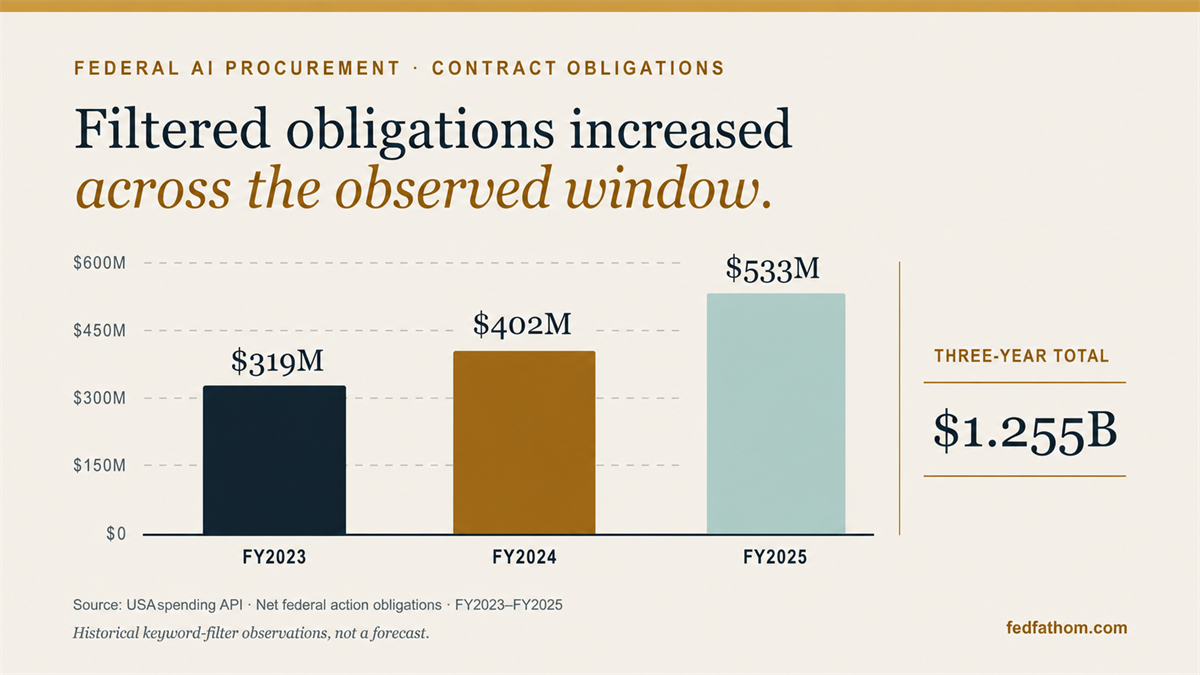
The unrounded total is $1,254,842,578.39. Transaction obligations include positive obligations and deobligations. They are not contract ceilings, contractor revenue, or a forecast. The annual rows show more filtered obligations in FY2025 than FY2023, but three fiscal years do not establish a durable growth trend or predict FY2026.
Observed award records
A separate award-level request returned 1,196 unique contract awards across 12 complete result pages. The collected set contained no duplicate USAspending-generated award identifiers. Do not use this award count as a dollar denominator or combine it with the transaction-obligation total.
The five rows below had the highest USAspending Award Amount in the result. Award Amount is a different measure from obligations within the three-year window, so those values are neither reproduced nor summed here.
| Award ID | Recipient row | Awarding agency |
|---|---|---|
| W911QX20C0023 | ECS FEDERAL, LLC | Department of Defense |
| 140D0421C0002 | TUKNIK GOVERNMENT SERVICES LLC | Department of the Interior |
| W911QX20C0051 | SCALE AI, INC. | Department of Defense |
| W911QX20C0041 | PALANTIR USG INC | Department of Defense |
| W911QX17C0045 | ECS FEDERAL, LLC | Department of Defense |
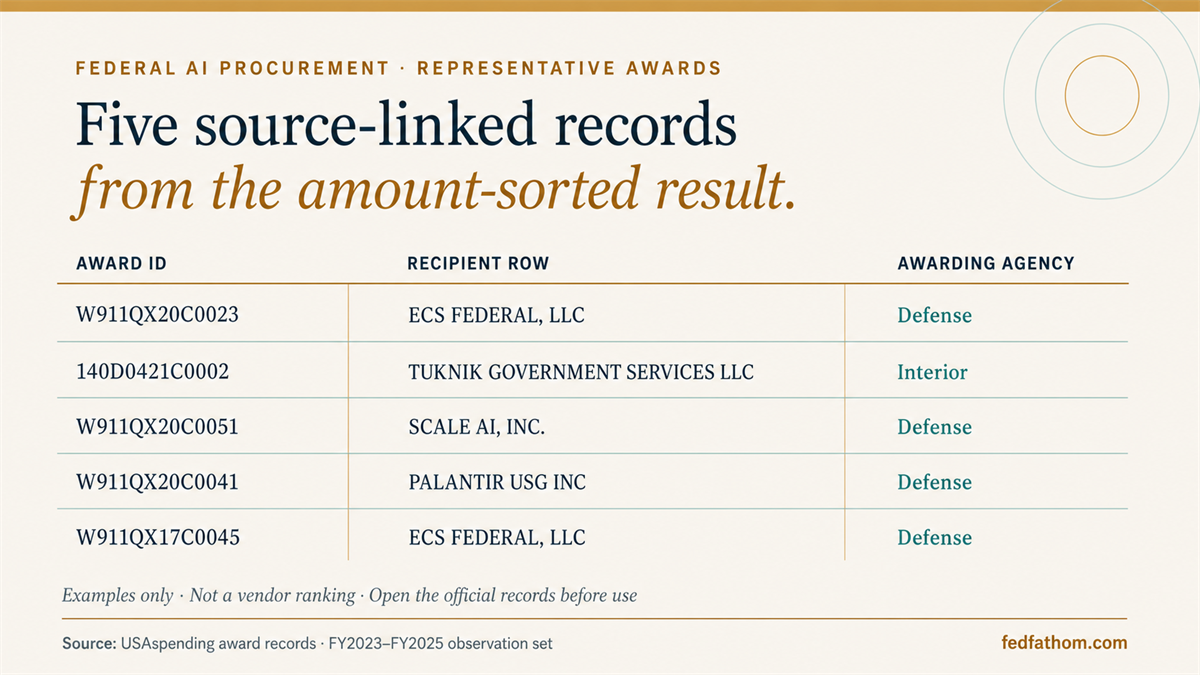
Four of these five examples were awarded by the Department of Defense and one by the Department of the Interior. That describes only this amount-sorted sample, not the agency distribution of all 1,196 awards. These are example federal award records, not a vendor ranking. Recipient names were not normalized to parent companies. Historical awards also provide no proof that a recompete or future solicitation will occur. Open each official record before treating it as an account-planning lead.
What a small-business owner should do next
1. Start with buyer and mission fit
Use the representative award records to identify missions, offices, and technical problems that resemble your past performance. Do not treat the keyword total as a list of equally relevant prospects.
2. Open the representative award records
Read the official descriptions, dates, modifications, recipients, and awarding organizations. A historical record is a starting point for account research, not a current opportunity.
3. Translate your capability into government language
Build a vocabulary from the actual mission and requirement language you find. Keep broad terms such as artificial intelligence beside the narrower outcomes, data types, systems, and services your business can credibly deliver.
4. Verify live demand in SAM.gov
Use SAM.gov Contract Opportunities as the free official source for current notices. Historical USAspending evidence can narrow monitoring, but it cannot confirm that an opportunity is active.
5. Treat history as a research lead
Confirm acquisition plans, incumbent status, small-business pathways, and periods of performance through current official sources and direct market engagement before committing pursuit resources.
Methodology and limitations
The official measurement used USAspending spending-over-time data grouped by fiscal year at the transaction level and spending-by-award data at the award level. Both requests used the same dates, award type codes, and combined keyword set. The exact annual obligation figures reconcile to $1,254,842,578.39. The award request ended after page 12 and reconciled 1,196 rows to 1,196 unique identifiers.
USAspending may revise historical data, controls its keyword matching, and notes that an award search can include additional periods when an award overlaps the requested period. The keyword set can miss relevant awards or include records that use a term in a different context. No classification code or keyword list defines the full federal AI market.
Official public sources
- USAspending for official historical spending and award records
- SAM.gov Contract Opportunities for current federal notices
- U.S. Small Business Administration local assistance for small-business contracting guidance